
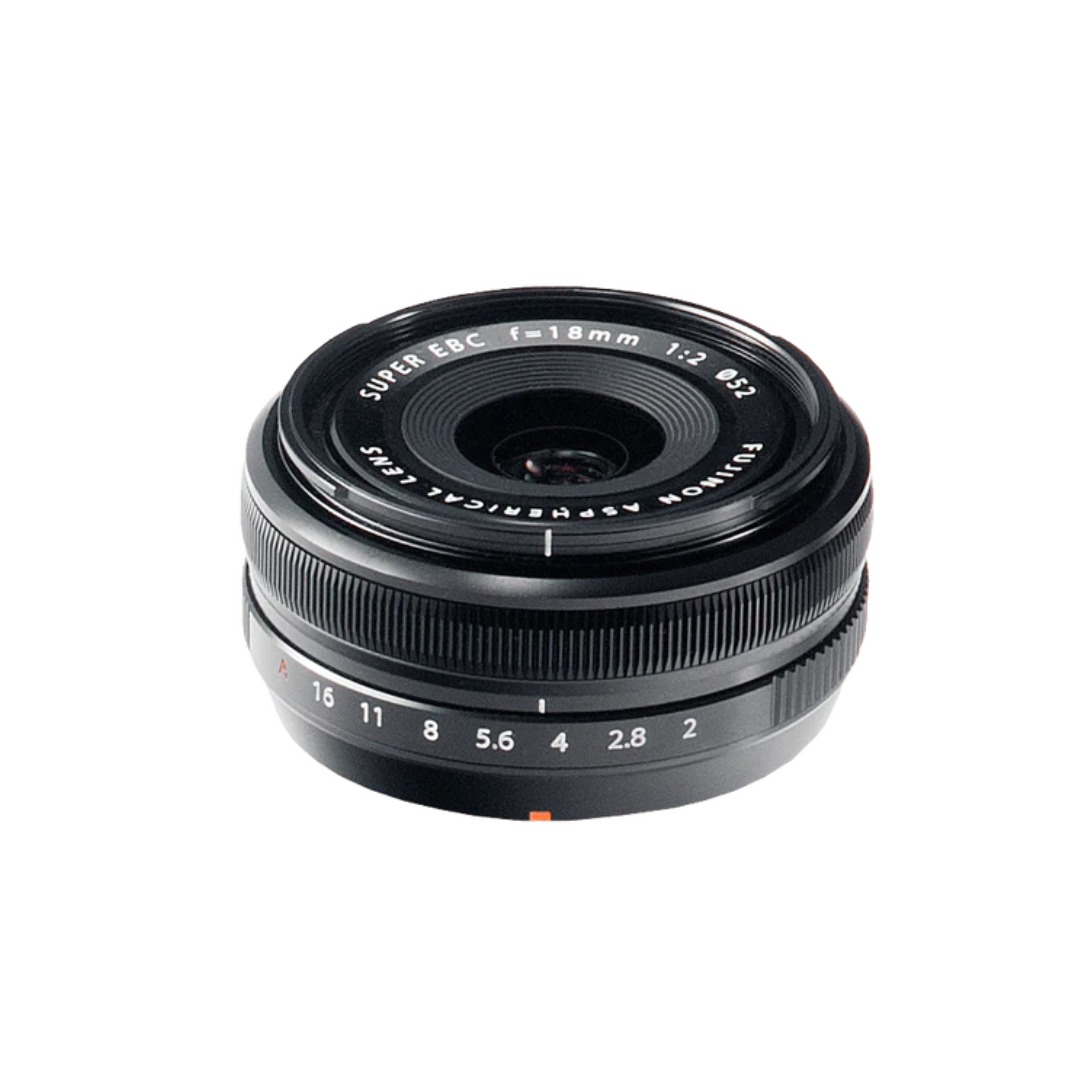
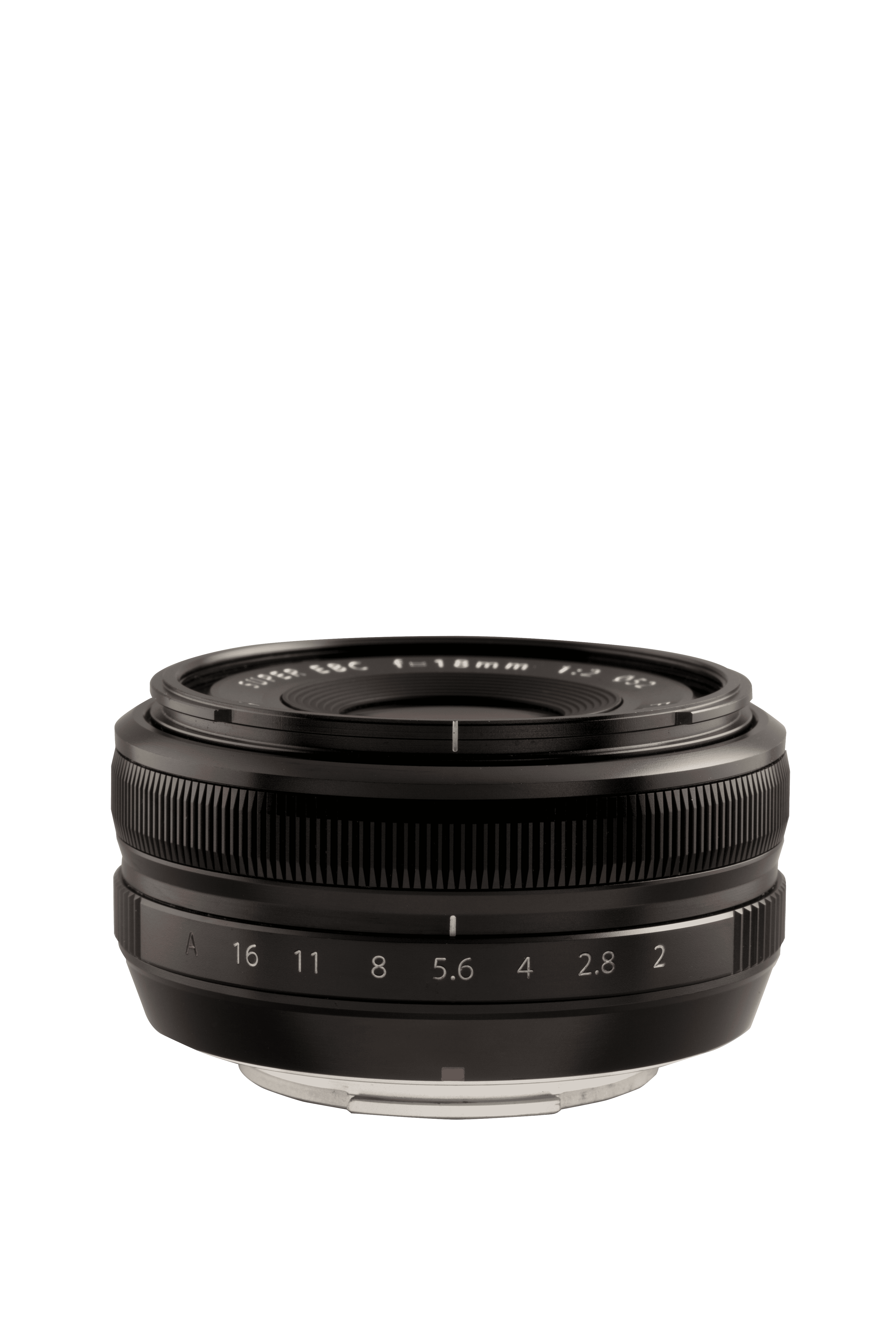
FUJIFILM XF18MMF2 R


Pairs well with
If you have any questions, you are always welcome to contact us. We'll get back to you as soon as possible, within 24 hours on weekdays.
-
Information
Share contact information, store details, and brand content with your customers.
-
Shipping Information
Use this text to answer questions in as much detail as possible for your customers.
-
Customer Support
Use this text to answer questions in as much detail as possible for your customers.

Compact and Lightweight Wide Prime
Specs
Description
This highly portable, easy-to-handle wide-angle lens has a field of view equivalent to 27mm in the 35mm film format so it’s perfect for landscapes, general snapshots, and by virtue of the 18cm minimum focusing distance, close-ups. The outstanding sharpness, combined with the maximum aperture of F2 for silky bokeh also makes it suitable for portraiture; the lens’ small size means your subjects won’t feel intimidated.
-
Compact and lightweight “Pancake” type.
-
Using glass-mold aspheric lenses at the 5th and 7th elements is effective in increasing the maximum aperture (5th element) and reducing the overall thickness of the lens (7th element).
-
The final element, positioned as closely to the sensor as possible, makes the incidence angle of light reaching the sensor smaller and reduces vignetting and color shading while helping to keep the lens’s overall size small.
Specification
| Model number | XF18mmF2 R |
| Release date | February 18, 2012 |
| Lens configuration | 8 elements in 7 groups (2 aspherical lenses) |
| Focal length | 18mm (35mm film equivalent: 27mm) |
| Angle of view | 76.5° |
| Maximum aperture | F2.0 |
| Minimum aperture | F16 |
| Aperture format | 7 blades (circular aperture), 1/3-step (19 steps total) |
| Shortest shooting distance | Standard: 0.8 m – ∞ Macro: 18 cm – 2.0 m |
| Maximum shooting magnification | 0.14× |
| External dimensions | Ø64.5 mm × 33.7 mm (from the tip to the mount reference surface) |
| Mass | Approximately 116 g (excluding lens cap and hood) |
| Filter size | Ø52 mm |
Origin & Manufacturer
- Country of Origin Japan
- Name of Manufacturer Fujifilm Corporation
- Address of Manufacturer 26-30, Nishiazabu, 2- Chome, Minato-Ku, Tokyo - 1068620, Japan
- Name & Address of Importer FUJIFILM India Private Limited Business Centre Office No. 521, Level V, Caddie Commercial Tower, Hospitality District Aerocity, IGI Airport, New Delhi - 110037
Included in the Box

Quick Start Guide

Lens

Lens hood

Lens Wrapping Cloth


FAQs
Please read our FAQs page to find out more.
Which Fujifilm camera is best suited for beginners or casual photographers?
The X-T30 III is ideal for classic manual dials and portability, while the X-S20 offers a modern DSLR-style grip with built-in stabilization. For pure point-and-shoot simplicity with a fixed lens, look at the X100VI.
What are Film Simulation modes and how do they work?
Film Simulations are in-camera color profiles that replicate classic photographic film stocks (like Velvia or Across). They adjust contrast, skin tones, and grain directly in-camera to deliver stylized, production-ready JPEGs without photo editing.
Can Fujifilm cameras be used for professional video production?
Yes. Advanced models like the X-H2S, X-H2, and X-T5 record up to 8K 30pand 6.2K 30p Open Gate, 4K 120p & FHD 240p (HFR) resolution, support Apple ProRes 4:2:2 10Bit, offer F-Log2 & F-Log2C profiles for maximum dynamic range, color space and feature full-size HDMI ports for external monitors.
Are Fujifilm lenses interchangeable across different models?
Lenses are interchangeable within the same system mount:
- X-Mount aka XF Lenses: Fits all interchangeable APS-C X-Series bodies.
- G-Mount aka GF Lenses: Exclusive to GFX Medium Format bodies.
- Fixed Lenses: Models like the X100 series feature permanently attached prime lenses.
How do I connect my Fujifilm camera to a smartphone or computer for transferring photos and remote control?
- Smartphone: Connect via Bluetooth/Wi-Fi using the FUJIFILM X App for wireless transfer and live remote control, or plug in directly via USB-C.
- Computer: Transfer files using an SD card reader or USB-C cable.
- XRaw Studio: FUJIFILM X RAW STUDIO and camera via USB cable, the processor in the camera will be used to process RAW files.
What is the difference between the Fujifilm X Series and GFX?
The X Series uses an APS-C sensor for everyday to professional photography, while the GFX System uses a much larger medium-format sensor built for high-resolution studio and landscape work.
Are Fujifilm cameras mirrorless?
Yes. Fujifilm's entire current lineup, including the X Series, GFX System and fixed-lens models, is mirrorless.
Which Fujifilm camera is best for beginners?
An entry-level X Series body with a kit lens is generally the easiest starting point, offering simple controls with room to grow into manual settings.